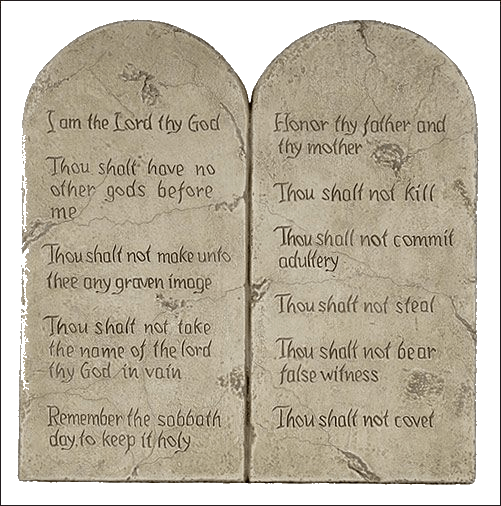
What are the commandments? Most people know them as the “Ten Commandments”. In Judaism they say the “Ten Words”. I find that interesting. Why you may ask? Well, for time’s sake, Jewish people call them the “Ten Words” because the Torah refers to them that way. It emphasizes God’s spoken communication rather than a list of strict rules (as most view them), highlighting their foundational, declarative nature.
Another reason they are not viewed as commandments is because the Hebrew Bible uses the word mitzvot for “commandments” — and there are traditionally 613 mitzvot in total. The “Ten Words” are viewed as a summary or core principles of the entire Torah, not just a set of individual laws.
So where did the word “commandment” come from? The term “Ten Commandments” comes from the Septuagint (ancient Greek translation), which uses the phrase deka logoi, also meaning “ten words.” That was translated into Latin as Decalogus and then into English as “Ten Commandments.”
So now we have the basis and where the term came from; do we need to obey them still? The short and sweet of it is yes, we still need to obey the Ten Commandments. Let’s look at both sides of this by looking at what they are and aren’t.
What they are not: A set of rules that keep us from having fun and something that was done away with when Yehoshua came to die for us. There is no evidence of Yehoshua “nailing” these to the cross, though there are some who like to pull out a verse and try to twist it into this way of thinking. The verse I’m referring to is Matthew 5:17, “‘Do not think that I came to destroy the Law or the Prophets. I did not come to destroy but to fulfill.’”
The very first part of this should be a key to what He was meaning. He clearly states that He did not come to DESTROY the law. This alone should be enough, but the thing is, they stop here and say, “See, He fulfilled the law, so we don’t need to obey it anymore.” But if they would continue, the next few verses state, “18 For assuredly, I say to you, till heaven and earth pass away, one jot or one tittle will by no means pass from the law till all is fulfilled. 19 Whoever therefore breaks one of the least of these commandments, and teaches men so, shall be called least in the kingdom of heaven; but whoever does and teaches them, he shall be called great in the kingdom of heaven. 20 For I say to you, that unless your righteousness exceeds the righteousness of the scribes and Pharisees, you will by no means enter the kingdom of heaven.”
This is why we read a verse within the context in which it was written. If you haven’t, read over my other blog on the Bible, which reiterates how to read the bible and why taking a verse out of context is not how God meant for us to use His word.
Now that you know the whole conversation within this one verse, we can see that He is stating that the commandments are not done away with nor will be anytime soon, and woe to those who teach that. When Yehoshua states that He came to fulfill the law, He’s saying that He’s bringing back its original meaning. The word fulfill in Greek is Strong’s G4137 plēroō, pronounced play-ro’-o, meaning to make full, to fill up, complete, to bring to realization, realize. Part of this meaning is to fulfill, i.e., to cause God’s will (as made known in the law) to be obeyed as it should be and God’s promises (given through the prophets) to receive fulfillment.
So, with that stated, as with all Yehoshua’ teachings, He was teaching us how the commandments should be obeyed because this was lost through time. He was telling us that obeying God’s commands starts in the mind. That sin comes from not keeping them. What is sin? Well, in short, sin is lawlessness (1 John 3:4). Again, don’t just take that verse; read that section.
What is lawlessness? Well, that is not obeying the law or, in this case, God’s commandments. When Yehoshua was talking about adultery and murder, He was making the point that all sin starts with our thoughts. Think about it this way…no pun intended…where do we get the notion to steal, covet, or any of the other “though shall not’s”? It first develops in our minds. Human reasoning can lead to the breaking of the commandments if we don’t stop it there. First, the thought is born, and then pondering on that thought, and finally, it can lead to action if we don’t dismiss it there.
What the commandments are: God’s law but much more. If we ALL obeyed ALL of the commandments, life as we know it would be 100% better. There would be no need for locks on doors, guns for protection, fences to separate us, etc., I could go on and on, but I think you get the point. They are a way of life that brings peace and love for others. When Yehoshua stated about summing up the commandments into one statement (again, not putting them away) it was to love one another as yourself. Would we want someone to steal from us? No. Or would we want a person to hurt us by hitting or even shooting us? No. So then we should not do that to other people. If we all thought like that, life would be so much better, but unfortunately, we don’t. Why? One reason is because of the commandments not being followed, and two, our adversary is still part of this world, but again, that is another subject I will get to at another time.
One other thing before I stop on this subject is the fact that, yes, some do obey the commandments for the most part but they tend to pick and choose which ones. That’s like picking and choosing which government laws to obey. Well, I’ll pay my taxes but I don’t want to do the speed limit. They are both part of our laws, but speeding may result in a ticket or, even worse, an accident, maybe even involving the death of someone or yourself. They are there for a reason. Just like all of God’s laws are there for a reason. The main one I’m referring to is the 4th commandment, keeping the Sabbath (Exodus 20:8-11).
This was modeled after God’s rest from creation. This was not just a commandment given to the “Jews” as most think. It was established when God rested on the seventh day after creating all things. If everyone would actually rest on this day as God intended, life would be so much better. We need this day to unwind from this hectic world, put all those cares away for just one day, and concentrate on the one that created us. Which day is the Sabbath you may ask? Well, that is another subject. The point is, don’t just pick and choose laws, whether they are our government or God’s; they are all there for a good reason, even though we may not like them.
Hope you found this helpful. If you like to know more go to https://www.ucg.org/learn/bible-study-aids/ten-commandments
 Answered Scripture
Leave a comment